Audit Trails: Why an Immutable Transaction History Matters
Most bookkeeping errors are not caught when they happen. They surface weeks later, during reconciliation or a dispute, when someone asks a question the ledger cannot answer: what did this record say before, and who changed it? An immutable transaction history answers that question by default, and the difference between having that answer and guessing at it is the difference between a book you can defend and a book you merely hope is correct.
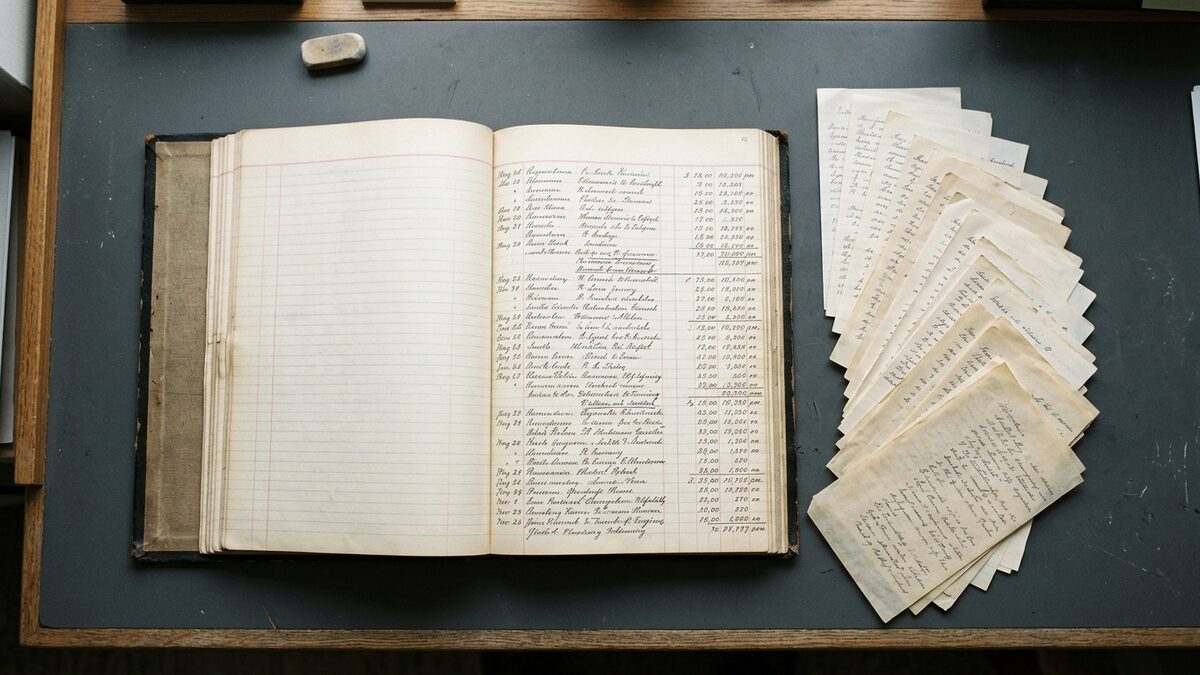
Consider two systems that handle the same correction differently. In the first, an operator opens a posted transaction, changes the amount from 1,240 to 1,420, and saves. The field now reads 1,420. The prior value is gone. If anyone later disputes the figure, the system has nothing to say about what the record used to be or when it changed. The correction was real, probably even right, but it left no trace.
In the second system, the same correction creates a logged event. The record still reads 1,420, but the history retains the 1,240 value, a timestamp, and the account that made the change. Nothing was destroyed; a new entry was appended describing what happened. This is the append-only model, and it is the foundation of an audit trail worth trusting.
The distinction sounds academic until the first time a number is questioned. Silent overwrite editing optimizes for a clean present state and discards the past to get there. Append-only editing treats every state the record has ever held as data you might need later. For anything financial, later almost always arrives.
Why silent overwrites quietly erode trust in your books
A ledger is only as credible as your ability to explain it. When corrections overwrite prior values without a record, three problems compound over time. First, you lose the ability to distinguish a legitimate fix from an accidental one, because both look identical after the fact: a single current value with no context. Second, reconciliation becomes forensic guesswork. If a bank feed and your ledger disagree by 180, and the ledger has been silently edited twice since the transaction posted, you cannot tell whether the discrepancy is a bank error, a keying error, or a correction that itself introduced the gap.
Third, and most damaging, is that overwrite systems make it impossible to prove good faith. Being right is not the same as being able to show you were right. When a vendor, a partner, or an auditor challenges a figure, the useful answer is not a confident assertion; it is a record. Overwrite editing forces you to defend your books with memory, and memory is not evidence.
There is also a subtler cost. Teams that know edits are logged behave differently than teams that know edits vanish. A visible history creates accountability without ceremony. Nobody needs a policy document telling them to be careful when the system itself remembers every change and attributes it. The audit trail is not surveillance; it is the quiet structural reason a correction stays honest.
How Ledgee records what changed, when, and by whom
Ledgee treats the transaction history as append-only by design. A posted entry is never mutated in place. When you correct a figure, reclassify an account, or void a transaction, Ledgee writes a new event that references the original and captures the delta: the field affected, the value before, the value after, the timestamp, and the acting user. The current view of your books reflects the latest state, so day-to-day work stays clean and readable, but the full lineage sits underneath any record you open.
This changes reconciliation from reconstruction to review. When a ledger balance and an external statement diverge, you do not have to reason backward from a single mutated value. You open the history and read the sequence of changes in order. A correction made on the fourth of the month with the prior value attached tells you exactly what happened and when, which usually collapses a multi-hour investigation into a two-minute read.
Dispute resolution follows the same pattern. When a counterparty questions an amount, the append-only record lets you produce the transaction as it was originally entered, every correction applied since, and the timing of each. You are not arguing from your recollection of events. You are showing the record, and the record is complete because nothing was ever thrown away to reach the current state.
The same structure supports voids and reversals cleanly. Rather than deleting a mistaken transaction, Ledgee marks it reversed and appends the reversing event, so the books balance correctly while the history preserves the fact that the original entry existed and was undone. This matters for period integrity: a transaction that touched a closed period should never simply disappear, because its disappearance would silently change a total someone already relied on.
None of this requires you to think about the mechanism during normal work. You edit, correct, and void the way you always would. The difference is that Ledgee refuses to forget, and that refusal is what turns a set of numbers into a set of numbers you can defend. An immutable history does not make your books correct on its own; it makes them accountable, which is the precondition for trusting them at all.
The practical test is simple. Pick any transaction in your current system and ask what it said last week, and who last touched it. If the system cannot answer without you reaching for a memory or a spreadsheet kept on the side, the audit trail is not doing its job. A ledger that can answer that question for every record, going back to the day it was entered, is a ledger you can hand to an auditor, a partner, or a future version of yourself without a caveat.