Why Manual Tracking Beats Auto-Sync for Personal Finance
Auto-syncing apps promise to do the boring work for you. They also let you ignore your money for months at a time. The case for typing your spending in by hand is not nostalgia — it is that the typing is the point.
The problem with frictionless
The pitch for auto-sync is simple: connect your accounts, the app reads your transactions, you get pretty charts, you do not have to do anything. Tens of millions of people have tried this exact pattern. Most of them, six months in, look at the charts maybe once a quarter and have no clearer sense of where their money goes than they did before signing up.
This is not because the apps are bad. It is because the friction was the feature. Manually entering a transaction is the moment your brain registers what you actually spent, on what, why. Skipping that moment removes the only chance most people get to update their internal model of their own finances.
What three minutes a day actually buys you
The committed manual tracker spends about three minutes a day on this. Sometimes less. You write down what you spent, on what, in what category. That is the entire workflow.
What you get for those three minutes is real-time awareness. You know that you spent $80 at Trader Joe's this week because you wrote it down. You know last weekend cost $140 because you wrote that down too. The total in your head is approximately accurate at all times because your hand kept it that way.
Auto-sync users almost never have this. They have an app that knows. They themselves do not.
The categories problem
Auto-sync apps have to guess at categories from merchant names. Target is "shopping" — except your Target run was 80 percent groceries. Amazon is "online" — except half the orders are work expenses. Venmo is "transfer" — except that one was your share of dinner. Manual tracking solves this because you remember why you were at Target and what you ordered from Amazon, and the category goes in the column the moment you write it.
This sounds minor. It compounds. After a year, your categories are accurate. After three months on auto-sync, your categories are mostly noise.
The patterns you only notice manually
Patterns in your spending hide in friction zones. You buy coffee in the morning when you are tired. You order delivery on weeknights when you got home late. You impulse-shop on Sunday afternoons when you are anxious about Monday. These are not patterns an algorithm flags — the algorithm sees five DoorDash transactions and tags them "Restaurants." You see the same five transactions and notice they all happened on Tuesdays after the meeting that always runs late.
That noticing is what changes behavior. You do not need to delete DoorDash. You need to know that the standing 6 PM Tuesday meeting is costing you $47 a week in delivery food. Manual tracking makes that visible. Auto-sync averages it out into the category total.
The objection you are about to raise
"What about people who do not have time?" This is the most common pushback, and it is mostly wrong. Three minutes a day is less time than people spend scrolling Instagram in the bathroom. The actual obstacle is that manual tracking forces you to confront things, and most people would rather not confront them.
If three minutes a day is genuinely too much, two minutes a week works almost as well. Save your receipts in your wallet, then sit down once a week and process the pile. The total time is the same; the cadence is different.
What a working manual system looks like
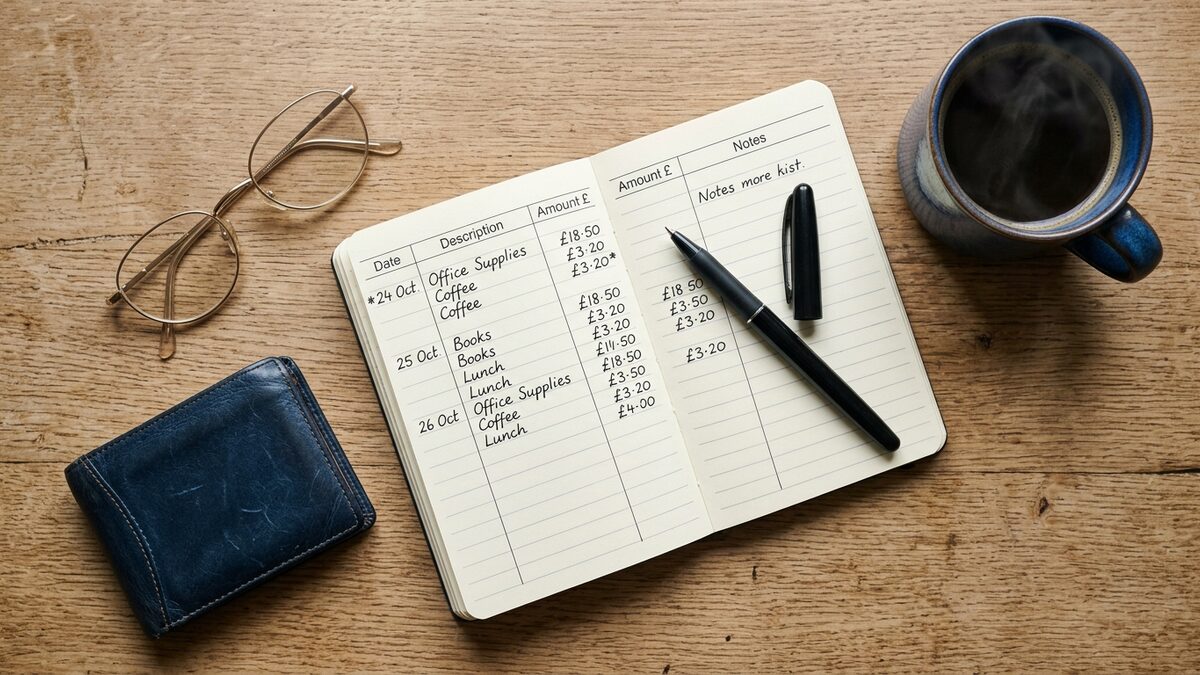
It is not complicated. A small notebook in your bag works. A spreadsheet on your phone works. A plain text file in your notes app works. Ledgee works. The point is not the medium. The point is the entry.
Columns most people end up with: date, description, category, amount, and (optionally) notes. Categories should be your categories — not the app's. Six to ten is plenty. Most people end up with something like: groceries, dining out, transportation, fixed bills, fun, savings, and "other." Refine over the first month. Do not let the system become more important than the doing.
The hybrid approach that actually works
Some people land on a middle ground: log every cash and debit card purchase manually as it happens, and reconcile the credit card statement once a month against your manual log. The credit card itself is auto-tracking; you are just verifying. This catches errors, double-charges, and forgotten subscriptions. Most importantly, it forces a monthly check-in where you actually look at the data.
If you do this for six months, you will know more about your money than 90 percent of the people you know. The reason is not that you are smarter. It is that you spent three minutes a day where almost everyone else spent zero.
What to do next
Pick a tool. Notebook, spreadsheet, app — whichever you will actually use. Start tomorrow morning. For the first two weeks, just log; do not analyze. After two weeks, look back at the entries and write down the three things that surprised you. Adjust one habit. Keep logging. The compounding starts immediately, but you have to do the writing.